A new noise is information. A new smell is usually a warning.
Cars are fairly good at telling you what is wrong, if you know the vocabulary. Most of it comes down to when the noise happens — braking, turning, going over bumps, or rising with engine speed — because that tells you which system is making it.
1. What it probably is
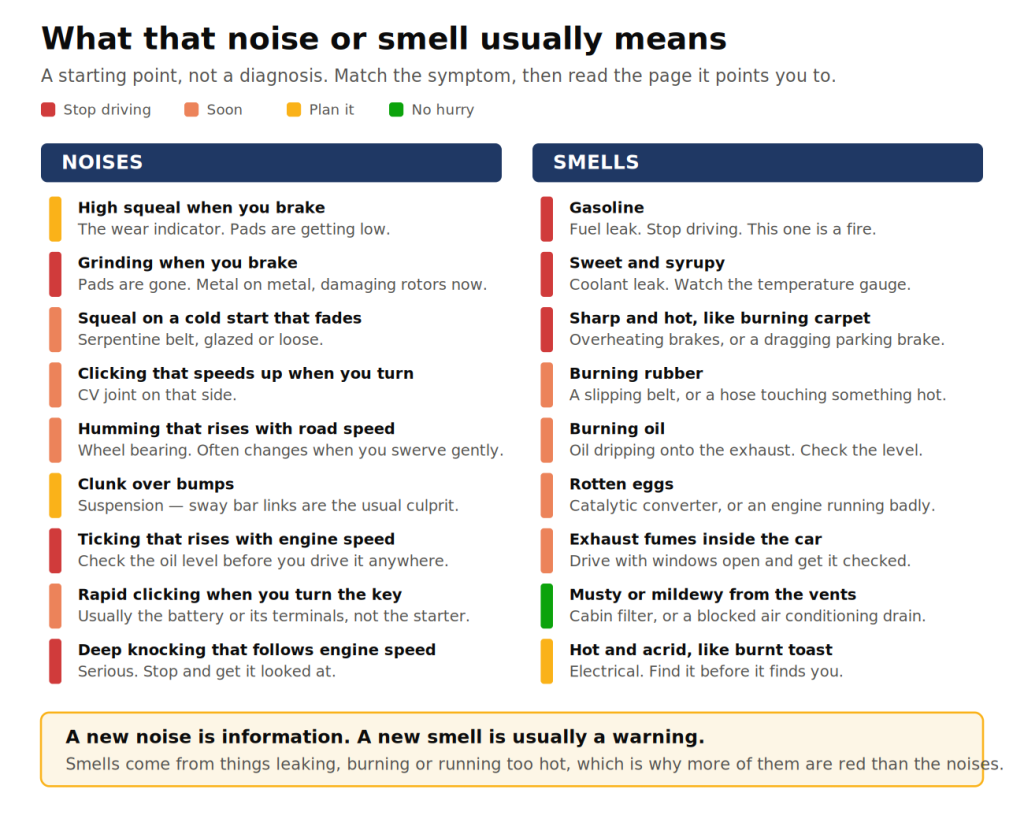
Noises
- High squeal when braking — the wear indicator. Pads getting low. Plan the work. See brake problems.
- Grinding when braking — pads gone, metal on metal. Deal with it now.
- Squeal on a cold start that fades — serpentine belt, glazed or loose.
- Clicking that speeds up when you turn — CV joint on that side.
- Humming or droning that rises with road speed — wheel bearing. Often changes pitch if you swerve gently from side to side.
- Clunk over bumps — suspension. Sway bar links are the usual and cheapest culprit.
- Ticking that rises with engine speed — check the oil level before driving anywhere.
- Deep knocking that follows engine speed — serious. Stop and have it looked at.
- Rapid clicking when you turn the key — not the engine at all. See it won’t start.
Smells
- Gasoline — a fuel leak. Stop driving. This one is a fire risk, not an inconvenience.
- Sweet and syrupy — coolant. Watch the temperature gauge and see overheating.
- Sharp and hot, like burning carpet — overheating brakes, or a parking brake left dragging.
- Burning rubber — a slipping belt, or a hose resting against something hot.
- Burning oil — oil dripping onto the exhaust. Check the level.
- Rotten eggs — catalytic converter, or an engine running badly enough to overwhelm it.
- Exhaust fumes inside the car — drive with the windows open and get it checked promptly.
- Hot and acrid, like burnt toast — electrical. Find it before it finds you.
- Musty from the vents — cabin filter or a blocked air conditioning drain. Annoying, not urgent.
2. The five-minute check
Pin down when it happens. That single question does most of the diagnostic work, and it is also what a shop will ask you first:
- Only when braking? Brakes.
- Only when turning? CV joints or power steering.
- Rises with road speed but not engine speed? Tyres, wheel bearings, brakes.
- Rises with engine speed even in neutral? Engine or belt driven.
- Only over bumps? Suspension.
- Only when cold, fading after a minute? Usually a belt, and usually minor.
Record it on your phone. Noises are famously shy at the garage. A ten-second video with the sound on, and a note of what you were doing at the time, is worth more to a mechanic than any description you can give at the counter — and it stops the visit becoming a paid hunt.
Two free checks worth doing before anything else: look at the oil level, and look underneath for puddles. Between them they explain a surprising number of noises and most smells.
3. Can you fix it yourself?
Some of them, yes. A musty smell is usually a cabin filter, which is a ten-minute job. Low oil is a top-up. A burning smell from a plastic bag caught on the exhaust is exactly what it sounds like and costs nothing.
Brakes are doable with the $300 kit. Belts are sometimes doable. Wheel bearings, CV joints and suspension are shop work — they need the car properly in the air and often a press.
Gasoline smell, exhaust fumes in the cabin, or deep engine knocking are not DIY situations. Those are stop-driving situations.
4. What a shop should charge
| Common culprit | At a shop | DIY parts |
|---|---|---|
| Cabin air filter | $40–$100 | $10–$30 |
| Serpentine belt | $90–$250 | $20–$45 |
| Brake pads, per axle | $100–$300 | $35–$150 |
| Sway bar links, pair | $150–$350 | $30–$80 |
| Wheel bearing, per wheel | $300–$800 | $50–$180 |
| CV axle, per axle | $350–$650 | $80–$200 |
| Diagnosis of an unidentified noise | $100–$200 | — |
5. What to watch out for
- “We’ll replace these and see if the noise goes away.” That is you paying for guesses. Ask what was found, not what will be tried.
- A whole suspension quoted for one clunk. Sway bar links are cheap and are the usual cause. Ask which component was actually found to be loose.
- Both wheel bearings when only one hums. They do not fail in pairs the way brakes wear in pairs.
- An air freshener as the fix for a musty vent. That is covering a filter that needs changing.
- A diagnostic fee with nothing found. Fair enough if they genuinely looked — but ask up front what happens if they cannot reproduce it.
A starting point, not a diagnosis. See the disclaimer.