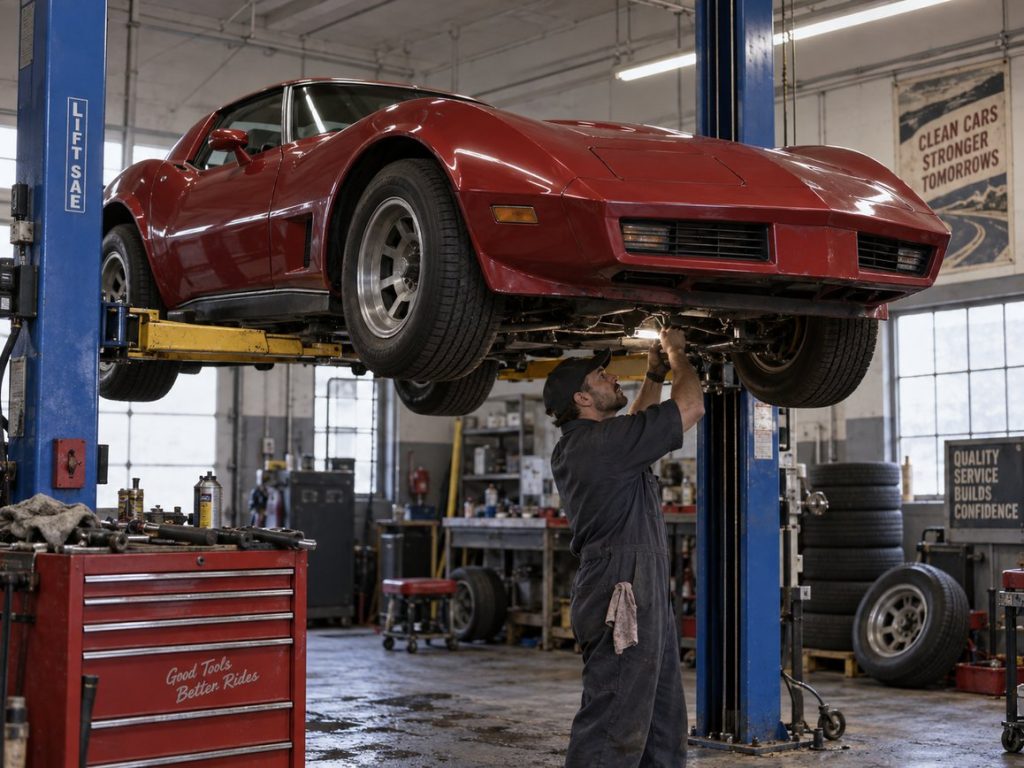
Ten questions, asked at the counter before you hand over the keys. None of them are confrontational, and all of them change how the visit goes.
You are not interrogating anybody. You are showing that you expect the ordinary things — written prices, named parts, a warranty — and that changes the conversation before it starts. A good shop will answer all ten without blinking, and some will be pleased you asked.
Print this or keep it on your phone. Nobody remembers ten questions standing at a service counter with somewhere else to be.
Before any work starts
1. “Can I get the estimate in writing before anything is done?”
The single most useful sentence there is. In Illinois you are entitled to a written estimate on any repair expected to run over $100. How a shop reacts to this question tells you most of what you need to know about them. Full detail on getting a written estimate.
2. “What’s your hourly labor rate?”
Independents typically run $80–$130 an hour, dealers $130–$200. Knowing the rate lets you check the labor line on the estimate: hours times rate should equal the number. If it does not, ask why.
3. “What’s the diagnostic charge, and is it credited toward the repair?”
Diagnosis is real work and deserves paying for — typically $100 to $200. What you want to know is whether it disappears into the final bill if you have the work done there, or sits on top of it. Both are normal. Being surprised by it is not.
4. “Will you call me before doing anything not on this estimate?”
They are required to get your consent before exceeding the estimate, but asking sets the expectation out loud. Add the sentence that matters: “and please send the revised estimate in writing before you start.” A text or an email is fine.
5. “Can I have the old parts back?”
Ask at drop-off, never at pickup. You almost certainly do not want a box of greasy parts — that is not the point. The point is that a shop which knows the old parts are going home with you bills differently. Two exceptions worth knowing: parts returned to the manufacturer under warranty, and parts with a core charge, which have to go back to the supplier.
6. “What parts are you using — OEM, aftermarket or remanufactured?”
All three are legitimate. Aftermarket is often identical to what the factory fitted and cheaper. Remanufactured is sensible for alternators and starters. What you are checking is that you know which you are paying for, because the price difference is large and it should be stated on the estimate.
7. “What’s the warranty on the parts and the labor?”
12 months / 12,000 miles and 24 months / 24,000 miles are both common. Get it written on the invoice — a verbal warranty is worth exactly what a verbal estimate is worth. Also ask whether it is honoured anywhere or only at that location, which matters if you travel.
When they recommend something
8. “What happens if I don’t do this today?”
The most useful question on the list. A real safety problem produces a specific answer: “the pads are at 2 mm, you’ll be into the rotors within a month.” An upsell produces a vague one, or a change of subject. You are not asking them to justify themselves — you are asking them to be specific, and honest people find that easy.
9. “Is that a safety item or a maintenance item?”
Forces the recommendation into one of two boxes, on the record. Safety items get done now. Maintenance items can be planned, spread out, or done yourself. Plenty of things sold with urgency turn out to belong in the second box.
10. “Can you show me?”
Most shops will happily walk you out to the car or show you a photo. Seeing a cracked belt or a leaking shock makes the decision obvious, and a shop that shows you things is usually one you can keep going back to.
One caution, because being shown something is not the same as it being yours: the classic version of this trick is a filthy air filter or a jar of dark fluid produced from a shelf rather than from your car. Asking to see it in place, still fitted, is the version that means something.
Two things to say, not ask
“Do only what we agreed, and I’ll think about the rest.” You are not obliged to decide on extra work in thirty seconds on a phone call at work. Saying this out loud is allowed and it is not rude.
“I’d like to get a second opinion on that.” Especially on anything over about $500. An hour of your time against a few hundred dollars is good odds, and you now have a written estimate to show the second shop.
At pickup
Put the invoice next to the estimate before you pay. They should match, allowing for the 10% if the estimate was itemized and you approved any extras. The invoice must itemize parts and labor, show the odometer reading, state the warranty, and give the total.
And if the shop got all ten of these right, write the name down. A mechanic you trust is worth more than any amount of research, and they are much easier to find when you know what you are looking for.
A plain-language summary of Illinois practice, not legal advice. See the disclaimer.