Some brake symptoms can wait a week while you get a second quote. Some mean stop driving now. Here is which is which.
Stop driving and have it towed if: the pedal sinks slowly or goes to the floor, there is fluid on the ground near a wheel, the car pulls hard to one side under braking, or you can smell burning after normal driving.
Brakes are the one system where waiting to save money can cost far more than money.
1. What it probably is
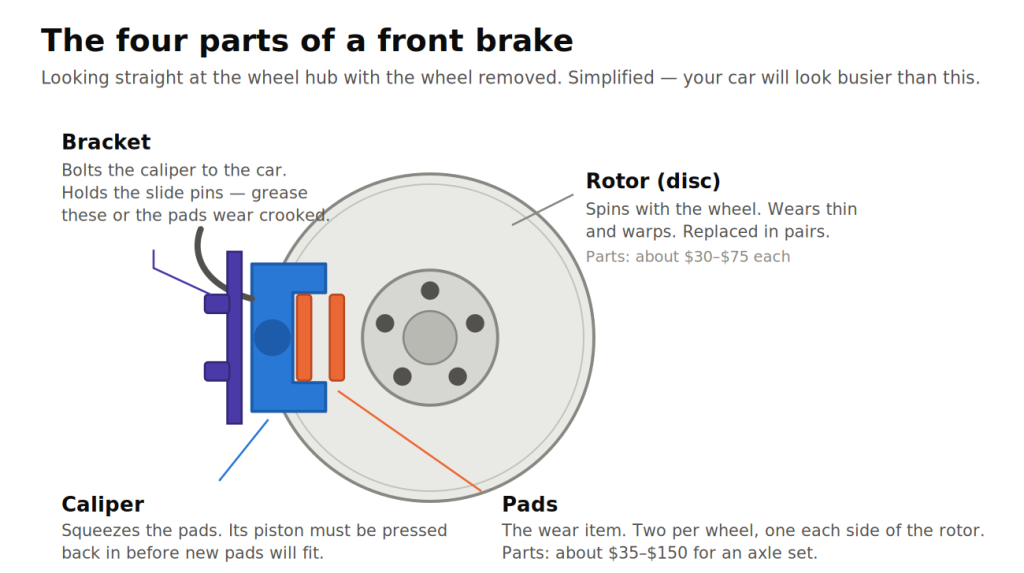
- A high squeal that stops when you brake — the wear indicator, a small metal tab designed to make exactly that noise. Pads are getting low. Plan the work; you are not in danger this week.
- Grinding — the pads are gone and it is metal on metal. Every mile from here is also destroying rotors, which turns a $200 job into a $500 one.
- Pulsing pedal or a shudder through the wheel when slowing from speed — warped or unevenly worn rotors.
- Soft or sinking pedal — air or a leak in the hydraulic system. This is the serious one.
- Pulling to one side — often a sticking caliper on the opposite side.
- A squeal only in the first minute on a damp morning — usually just surface rust on the rotors burning off. Normal.
2. The five-minute check
Look through the wheel spokes. On most cars you can see the brake pad pressed against the rotor without taking anything apart. You are looking at the friction material, not the metal backing plate. Less than about a quarter inch — roughly two stacked quarters — means replacement is due.
Two more free checks. Look at the brake fluid reservoir under the hood: a level that has dropped noticeably means either worn pads or a leak, and both are worth knowing about. And after a normal drive, carefully hold your hand near each wheel — not on it. One wheel far hotter than the others points at a sticking caliper.
3. Can you fix it yourself?
Pads and rotors — yes, and it is the job that pays for the whole tool kit. A front pads-and-rotors job runs $200 to $500 at a shop and about $65 to $225 in parts. One job covers the tools with change left over.
It is an intermediate job, though, not a first one. If you have never taken a wheel off, do an oil change and a battery swap first. The full walk-through, including the safety rules and the mistakes that catch people, is in how to replace front brake pads and rotors.
Not a DIY job: anything hydraulic — a soft pedal, a fluid leak, a bleed. Calipers on an axle with an electric parking brake, which often needs a scan tool to retract. And anything where you are not completely confident the result is right.
4. What a shop should charge
| Job, per axle | At a shop | DIY parts |
|---|---|---|
| Pads only | $100–$300 | $35–$150 |
| Pads and rotors | $200–$500 | $65–$225 |
| Pads, rotors and calipers | $300–$800+ | $150–$400 |
| Brake fluid flush | $80–$200 | $10–$25 |
Every one of those is per axle. Front and rear are separate jobs. A quote that just says “brakes” without saying which end is a quote to ask about. Full breakdown: brake job costs.
5. What to watch out for
- All four corners quoted at once. Fronts do most of the braking and typically wear about twice as fast as rears. Ask for the millimetre measurement on each axle.
- “They’re low” instead of a number. A shop that has actually measured will tell you the millimetres. New pads are around 10 to 12 mm; most recommend replacement near 3 mm.
- Calipers “while we’re in there.” Calipers last a long time and get replaced when one is seized or leaking, not as routine maintenance.
- A fluid flush added to every visit. Brake fluid does need changing, but on an interval measured in years. Check what your manufacturer specifies.
- Machining charged alongside new rotors. New rotors do not need machining.
A starting point, not a diagnosis. See the disclaimer.