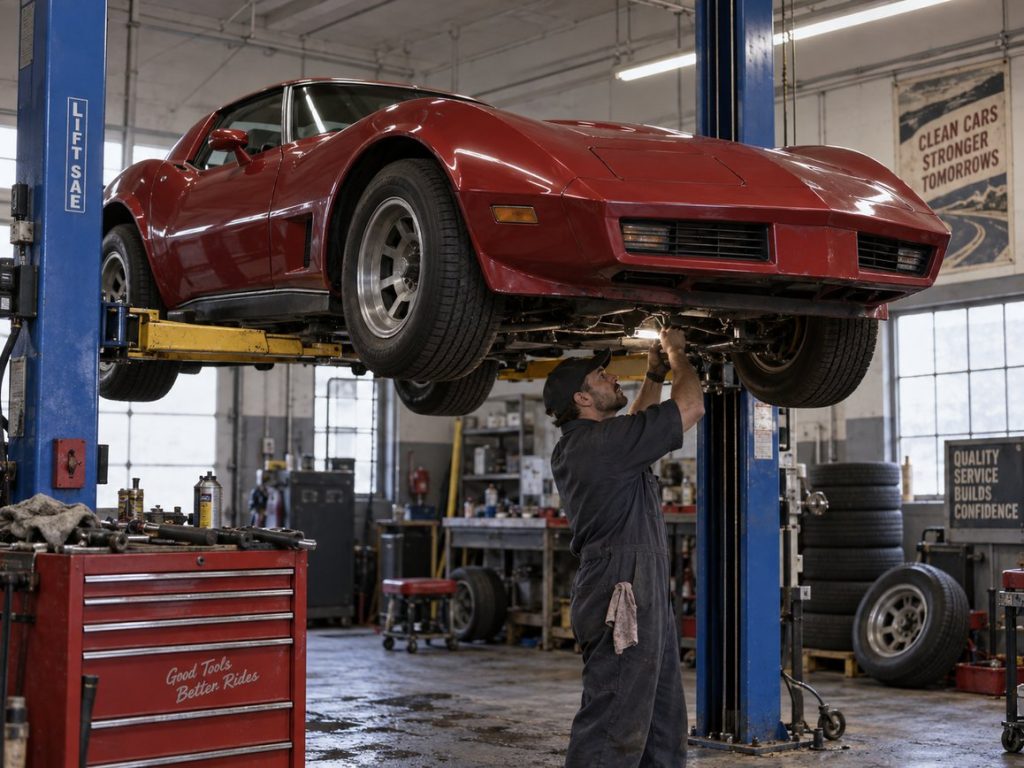
Four kinds of place will fix your car, and they are genuinely good at different things. The cheapest is not always the answer, and neither is the dealer.
Side by side
| Labor rate | Best for | Watch for | |
|---|---|---|---|
| Dealer | $130–$200/hr | Warranty work, recalls, software, brand-specific faults, very new cars | Highest prices, OEM-only parts policies, service-advisor upselling |
| Independent | $80–$130/hr | Almost everything on an out-of-warranty car | Quality varies enormously — the whole game is finding a good one |
| Chain | Varies | Tires, brakes, batteries, oil, alignments — high-volume routine work | Sales targets; free inspections that find things |
| Mobile mechanic | $70–$130/hr | Batteries, starters, alternators, brakes, diagnosis at your house | No lift, weather-dependent, limited for big jobs |
When the dealer is actually the right call
People treat “go to the dealer” as the expensive default, but there are cases where it is simply correct:
- Anything under factory warranty — it should cost you nothing.
- Recalls. Always free, at any dealer for that brand, regardless of the car’s age or who owns it now. Check yours at the NHTSA site with your VIN — genuinely worth five minutes.
- Software and module programming. Some jobs need factory-level tools, and an independent may not have them.
- A known pattern fault on your model. Manufacturers issue technical service bulletins, and the dealer sees the same fault weekly where an independent may see it once.
- A car that is genuinely unusual — hybrid, EV, low-volume European.
Worth knowing: you do not have to service at a dealer to keep a factory warranty. An independent can do scheduled maintenance as long as it is done to specification and you keep the receipts. Being told otherwise is not correct.
The independent, and how to find a good one
For most people with an out-of-warranty car, a good independent is the answer — similar work at roughly two-thirds the labour rate, and often the same technician year after year, which matters more than people expect.
The difficulty is that quality varies wildly, so it is worth finding one before you are stranded:
- Ask people locally who have owned their car a long time. A personal recommendation beats any review site.
- Look for ASE certification on the wall, and check how long they have been at that address. Longevity in one location is a real signal.
- Read the one and two-star reviews, not the five-star ones. You are looking for a pattern — repeated complaints about surprise charges or work not fixing the problem. One angry review means nothing.
- Check the Better Business Bureau and, in Illinois, whether there is a complaint history with the Attorney General.
- Test them with something small first. An oil change or a brake inspection tells you how they communicate, whether they write things down, and whether they try to sell you four things you did not come in for.
- Look for a specialist if you drive something particular. A shop that does mostly Hondas, or mostly diesels, is often better and cheaper on that car than a generalist.
Chains
Good at what they do a hundred times a week: tires, alignments, batteries, brakes, oil. The equipment is there, the price is competitive, and the warranty often travels between locations, which is genuinely useful.
The thing to be aware of is structural rather than dishonest: staff frequently work to sales targets, and the free inspection is a lead generator. Go in for what you came for, take any additional recommendations away to think about, and check them against the cost table before agreeing.
For complex diagnosis, a chain is usually not the right choice. Their model is volume, not hunting an intermittent fault for three hours.
Mobile mechanics
Increasingly common, and a genuinely good option for the right job. They come to your house or workplace, overheads are lower so rates often are too, and for a battery, starter, alternator or brake job it can be the easiest thing in the world.
The limits are physical. No lift, no alignment rack, no press, and nowhere dry to leave a car half apart when it rains. Anything needing the car in the air for hours, or a specialist machine, is not a driveway job.
Check they are insured, ask about the warranty and where it would be honoured, and be clear about who buys the parts.
The signals that matter more than the type
- They give you a written estimate without being asked twice.
- They can explain the repair in language you understand, and will show you the part on the car.
- They tell you what can wait, not only what is urgent. This is the single best sign there is.
- They call before exceeding the estimate.
- They put the warranty on the invoice.
A shop that does those five things is worth staying with even if it is not the cheapest quote you can find. And when you find one, write the name down — a mechanic you trust is worth more than any amount of research.
A plain-language summary, not legal advice. See the disclaimer.