Everyone thinks they know how to do this. The fourth connection is the one most people get wrong, and it is the one that matters.
- Time: 10 minutes, plus a 20-minute drive afterwards
- Difficulty: beginner — but there is a right order and a wrong one
- You need: jumper cables ($20–$40) or a jump pack ($60–$100), and eye protection
Before you connect anything
- Both cars off. Keys out, parking brakes on, both in Park or Neutral.
- The two cars must not be touching. Close enough for the cables to reach, not touching bumpers.
- Look at the dead battery. If it is cracked, leaking, visibly swollen or frozen solid, stop. Do not jump it — that is how batteries explode. Have it replaced.
- Identify the posts. Positive is marked +, usually red or under a red cover. Negative is −, usually black. Getting these backwards can destroy electronics in both cars.
The four connections, in order
- RED clamp to the dead battery’s + post.
- RED clamp at the other end to the good battery’s + post.
- BLACK clamp to the good battery’s − post.
- BLACK clamp at the other end to bare, unpainted metal on the dead car’s engine — a bolt head or a bracket, away from the battery. Not to the dead battery’s negative post.
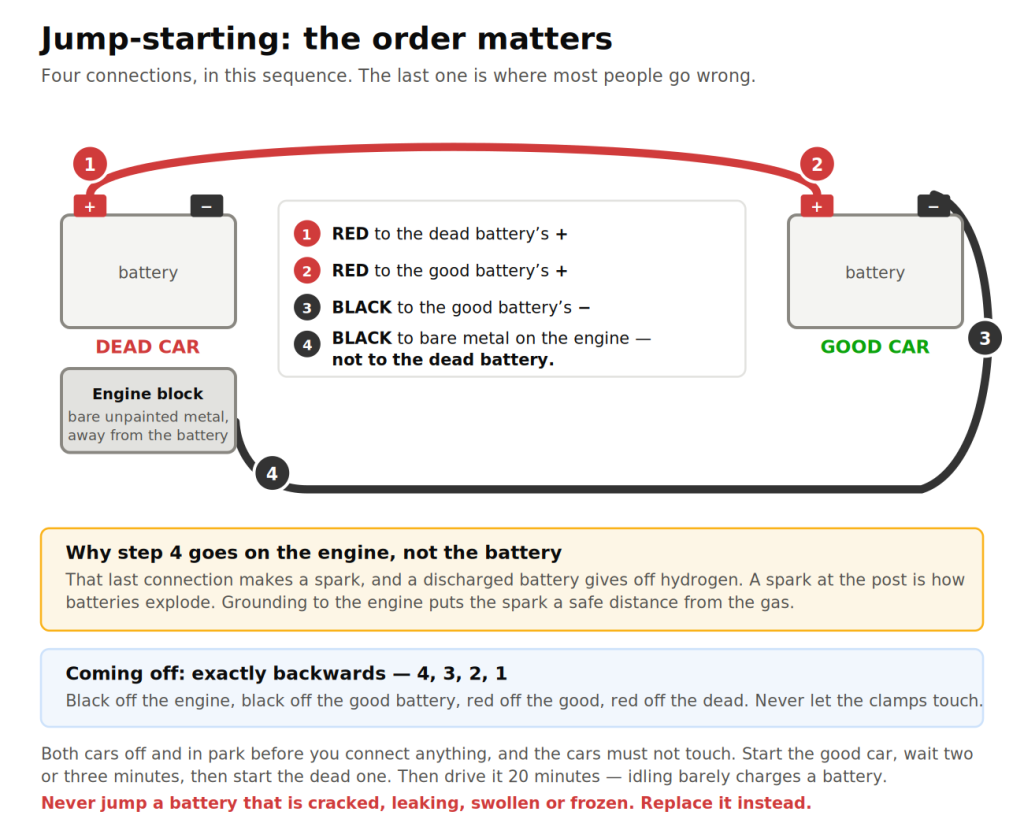
Why step 4 is not the battery post. That last connection completes the circuit and makes a small spark. A discharged battery is giving off hydrogen gas, and a spark right at the post is exactly how a battery explodes — which sprays acid over whoever is leaning across it.
Grounding to the engine block puts that spark a safe distance away from the gas. It works exactly as well and it is what every manufacturer’s manual tells you to do.
While you are connecting: never let the two clamps touch each other once one end is live, and do not let a clamp fall onto bodywork.
Starting it
- Start the good car and let it run two or three minutes. This puts some charge into the flat battery so the starter is not asking the cables to do everything.
- Try the dead car. If it fires, good. If it only clicks, wait another five minutes and try again — the battery may be very flat.
- Do not crank for more than about ten seconds at a time. Longer than that overheats the starter. Rest thirty seconds between tries.
- If it will not go after three or four attempts, stop. Something other than a flat battery is wrong.
Taking the cables off
Exactly backwards: 4, 3, 2, 1. Black off the engine block, black off the good battery, red off the good battery, red off the dead battery. Keep the clamps apart the whole time.
Then drive the jumped car for at least 20 minutes, ideally at road speed rather than round a car park. Idling barely charges a battery. If you switch off after five minutes you will very likely be jumping it again.
Jump packs
A lithium jump pack, $60 to $100, does the same job without a second car, and is genuinely worth having in the trunk if you drive an older vehicle or park somewhere quiet. Same connection order applies — red to positive first, black clamp to the engine block last.
Keep it charged. A jump pack that has sat flat in a cold trunk for two years is an ornament.
It started — now what?
A jump is a lift home, not a repair. Something made the battery flat, and you want to know which of three things it was:
- You left the lights on — fine, no further action.
- The battery no longer holds charge — it will do this again within days.
- The alternator is not charging — the car will die again while driving, which is a great deal worse than dying in a driveway.
Two meter readings tell you which: how to test a car battery. Most parts stores will also test both free.
The mistakes that catch people
- Black clamp on the dead battery’s negative post. The most common one, and the one with the worst outcome.
- Red on negative. Reversed polarity can take out alternators and control modules in both cars. Check twice.
- Clamps touching each other.
- Cranking and cranking. Ten seconds maximum, then rest.
- Switching off five minutes later. Twenty minutes of driving, minimum.
Information only, not professional advice. Work on your own vehicle is at your own risk. See the disclaimer.