
Before you buy a battery, spend two minutes and a $25 meter finding out whether the battery is actually the problem.
Battery, alternator and starter all fail in ways that look identical from the driver’s seat. Guessing wrong means buying a $150 battery to fix a $600 alternator problem — and then still being stranded. A multimeter separates them in about five minutes.
Which one sounds like yours?
- Rapid clicking, dash lights dim badly — classic dead or weak battery, or a bad connection at the terminals.
- One loud clunk, then nothing — points more toward the starter than the battery, though a very flat battery can do this too.
- Started fine this morning, died while driving — a battery does not do that. That is the alternator not charging, and the car ran until the battery was flat.
- Battery light on the dash while driving — that light means the charging system, not the battery. Alternator or its belt.
- Fine for a few days, then dead again — either a battery that will not hold charge, or something draining it while parked.
What you need
A digital multimeter, $20 to $40. That is the whole list. Nothing else, and nothing gets taken apart.
Safety, briefly but seriously
- A charging battery gives off hydrogen. No sparks, no flames, no smoking near it.
- Wear eye protection. Battery acid does not grow back eyes.
- Never let anything metal touch both terminals at once — a wrench, a ring, a watch strap. A car battery will happily dump hundreds of amps through it and it will glow.
- If the case is swollen, cracked, or leaking, do not test it. Take it to be recycled.
- When the engine is running, keep hands, sleeves and the meter leads clear of the belt and fan.
Test 1: the battery, engine off
- Let the car sit at least an hour, ideally overnight. Straight after driving, the battery holds a surface charge that reads high and lies to you.
- Set the meter to DC volts — the V with a straight line and dots, not the wavy line. If it is not auto-ranging, choose the 20 V setting.
- Red probe to the positive terminal (+), black probe to the negative (−). Touch the metal of the post or the clamp, not the plastic cover.
- Read the number and compare it below.
If the meter shows a negative number, the probes are simply the wrong way round. No harm done — swap them.
Test 2: the alternator, engine running
Start the engine and, keeping clear of the belt, measure across the same two terminals again. You should see 13.7 to 14.7 volts. That is the alternator charging the battery.
Below about 13.5 V, the alternator is not keeping up — suspect the alternator itself or a slipping or missing belt. Above 15 V, it is overcharging, which is a voltage regulator fault and will cook the battery. Now switch on the headlights, the blower and the rear defroster: the voltage should sag a little but stay above roughly 13 V. If it falls toward 12, the alternator cannot carry the load.
Test 3: the terminals themselves
Plenty of “dead batteries” are just bad connections. Look for white or blue-green crust on the posts, and try to twist each clamp by hand — if it moves at all, it is loose.
You can also measure it: with the engine off, put one probe on the battery post itself and the other on the clamp attached to it. You should read essentially zero. Anything above about 0.1 V there means the connection is bad, and cleaning it may fix your whole problem for nothing.
What the readings add up to
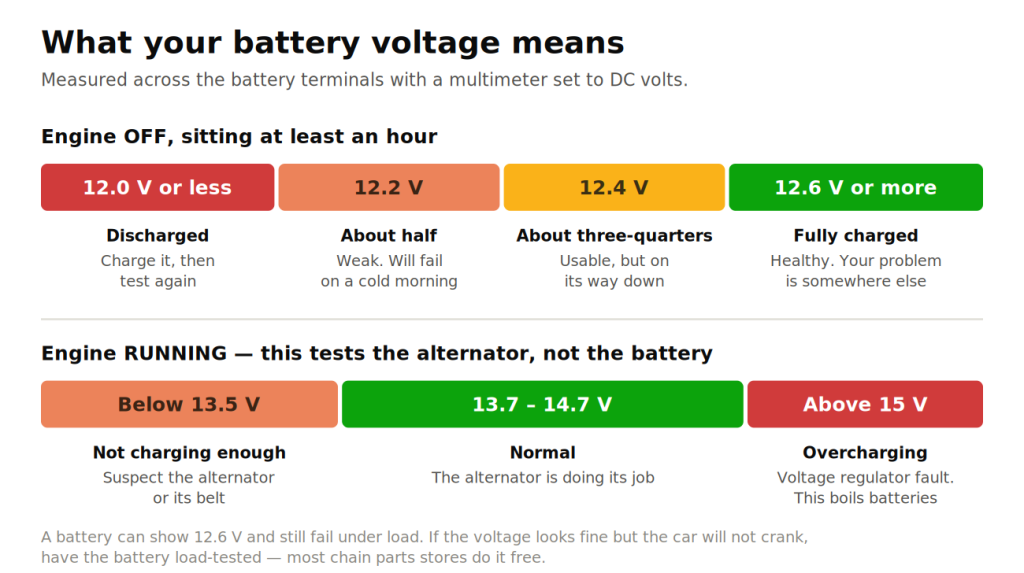
- 12.6 V+ resting, 13.7–14.7 V running — battery and alternator are both fine. Your problem is elsewhere: starter, ignition switch, a ground, or a security system.
- Low resting, normal running — the battery is not holding charge. Have it load-tested; it is probably done.
- Normal resting, low running — the alternator or its belt. The battery is a victim here, not the cause.
- Low on both — likely a failed alternator that has flattened the battery. Charging the battery alone will only get you a few more days.
The one thing a multimeter cannot tell you
Voltage is not capacity. A tired battery can read a healthy 12.6 V sitting still and still collapse the moment the starter asks it for 200 amps. That needs a load test, which uses different equipment.
Most chain auto parts stores will load-test your battery free, and will test the charging system with it. So the sensible order is: do these three tests yourself to find out which part of the system is misbehaving, then get a free load test to confirm before spending anything.
What it costs either way
- Battery: $120–$300 installed at a shop. $100–$220 for the battery itself, and on most cars it is a two-bolt job you can do in the parking lot.
- Alternator: $400–$1,000 at a shop, $150–$400 for the part. Not a beginner job on most cars.
- Starter: $400–$900 at a shop, $120–$350 for the part. Usually awkward to reach and often requires getting under the car.
Knowing which of those three you actually need is the entire value of the five minutes above.
Information only, not professional advice. See the disclaimer.