What you hear when you turn the key narrows this down before you touch anything.
Three different parts strand you in the same way, and they cost $120, $400 and $900 respectively. Guessing wrong means buying the cheap one, still being stranded, and then buying the expensive one anyway.
1. What it probably is
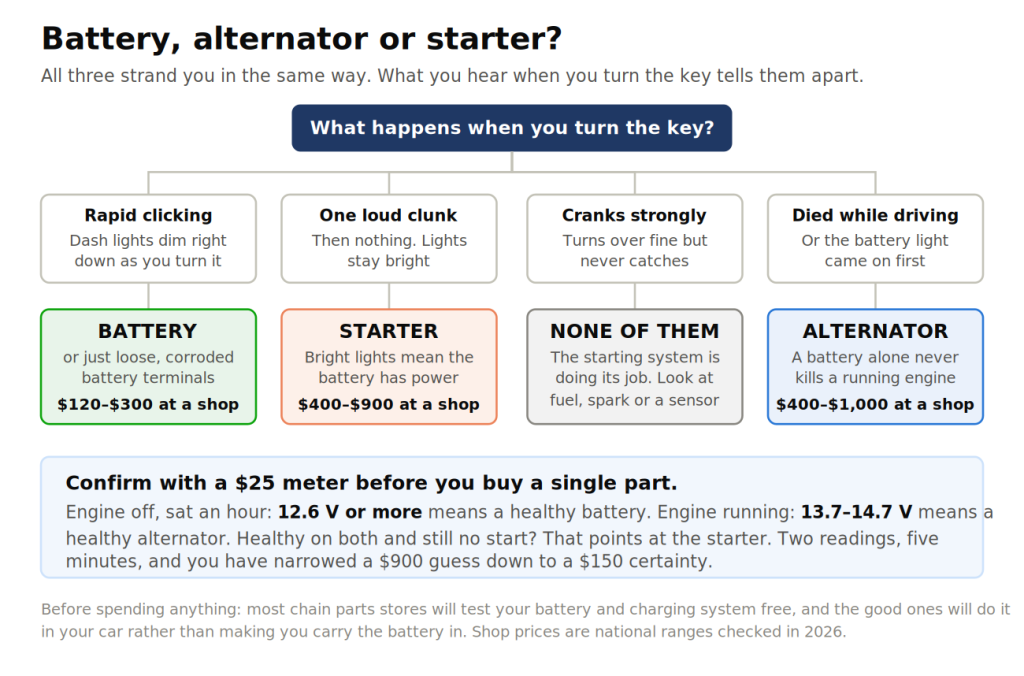
- Rapid clicking, dash lights dimming — the battery, or just loose or corroded terminals. Enough power to click, not enough to turn the engine.
- One loud clunk, then nothing, lights staying bright — points at the starter. Bright lights mean the battery has power.
- Cranks strongly but never catches — the starting system is fine. This is fuel, spark or a sensor.
- Died while driving, or the battery light came on first — the alternator. A battery on its own does not stop a running engine.
- Completely dead — no lights, no click, nothing — a flat battery, or a connection so bad nothing is getting through.
- Fine after a jump, dead again in a few days — a battery that no longer holds charge, or something draining it while parked.
2. The five-minute check
Before anything else, look at the battery terminals. White or blue-green crust on the posts, or a clamp you can twist by hand, is a genuinely common cause of a car that will not start — and it costs nothing to fix.
A couple of free sanity checks while you are there: make sure it is properly in Park (try Neutral — a failing safety switch is a real thing), and on a push-button car, try the spare key, because a dead key fob battery produces a car that does absolutely nothing.
Then take two readings with a $25 multimeter. Engine off and sat an hour: 12.6 V or more is a healthy battery. Engine running: 13.7 to 14.7 V means the alternator is charging. Healthy on both and still no start points at the starter. Full walk-through: how to test a car battery.
No meter? Most chain auto parts stores test batteries and charging systems free, and the better ones do it in your car.
3. Can you fix it yourself?
- Corroded or loose terminals — yes. A wrench, a wire brush and ten minutes. This is the best possible outcome.
- Battery — usually yes. On most cars it is a two-bolt job in a parking lot. Some newer cars, particularly European ones with stop-start, need the new battery registered with a scan tool — worth checking for your model first.
- Alternator — advanced. Belt routing and wiring, and on many cars it is buried.
- Starter — advanced. Usually requires getting under the car, which means jack stands and real care.
- Cranks but won’t catch — no. That is a diagnosis, not a part swap.
4. What a shop should charge
| Repair | At a shop | Part alone |
|---|---|---|
| Battery replacement | $120–$300 | $100–$220 |
| Alternator | $400–$1,000 | $150–$400 |
| Starter | $400–$900 | $120–$350 |
| Diagnosis, if it cranks but won’t start | $100–$200 | — |
Full detail, including core charges and reman versus new: battery, alternator and starter costs.
5. What to watch out for
- Battery and alternator sold together. Sometimes genuinely right — a dead alternator can ruin a battery. Often just a convenient pairing. Ask for the test results on each, separately.
- A new battery for dirty terminals. Ask whether the terminals were cleaned and the battery retested before it was condemned.
- A starter quoted off symptoms alone. A weak battery makes a starter sound like it is dying. The voltage test separates them in two minutes, and it is the expensive mistake in this group.
- A vague “charging system service.” Ask what is physically being done to the car.
A starting point, not a diagnosis. See the disclaimer.