Three different parts, three very different prices, and one identical symptom: the car will not start.
Getting this wrong is expensive in a specific way — you buy the cheap part, it does not fix it, and you buy the expensive one anyway. Five minutes of listening and one meter reading tells them apart.
What each one costs
| Part | At a shop | Part alone | Doing it yourself |
|---|---|---|---|
| Battery | $120–$300 | $100–$220 | Usually a two-bolt job |
| Alternator | $400–$1,000 | $150–$400 | Advanced — belt and wiring |
| Starter | $400–$900 | $120–$350 | Advanced — usually underneath |
Notice the pattern: on the battery, most of what you pay is the part. On the other two, most of what you pay is labor — they are buried, and getting to them is the job.
Telling them apart by ear
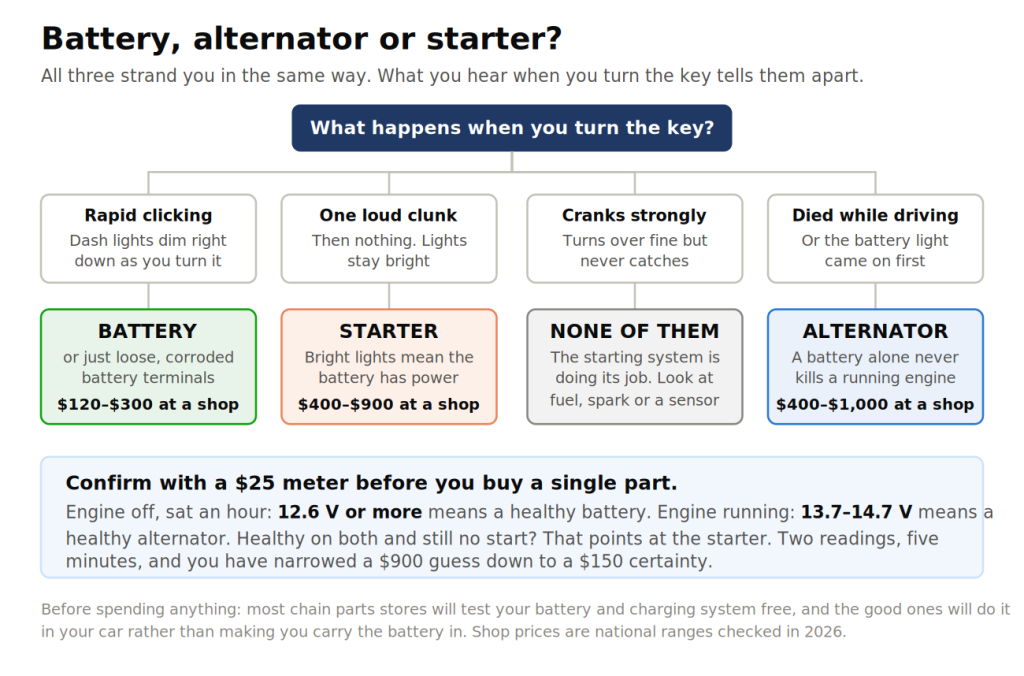
What you hear when you turn the key narrows it down before you touch anything:
- Rapid clicking, dash lights dimming right down — the battery. There is enough power to click the starter solenoid but not to turn the engine. Could also be nothing more than loose or corroded terminals, which is free to fix.
- One loud clunk and then nothing, lights staying bright — points at the starter. Bright lights mean the battery has power; something is not passing it on.
- Cranks strongly but never catches — none of these three. The starting system is doing its job. Look at fuel, spark or a sensor.
- Died while driving, or the battery light came on first — the alternator. A battery on its own does not kill a running engine; the engine ran until the flat battery could no longer feed the ignition.
- Fine for a few days after a jump, then dead again — either a battery that no longer holds charge, or something draining it while parked.
Confirming it for $25
A multimeter settles it. Engine off and sat an hour, 12.6 V or more across the battery terminals is healthy. Engine running, 13.7 to 14.7 V means the alternator is charging properly. Healthy on both readings and still no start points at the starter. The full walk-through is on how to test a car battery.
Free alternative: most chain auto parts stores will test your battery and charging system at no charge, and the better ones will do it in your car rather than making you carry the battery inside.
One thing a meter cannot tell you: voltage is not capacity. A tired battery can read a healthy 12.6 V sitting still and still collapse when the starter asks it for two hundred amps. That takes a load test — also free at most parts stores, and worth doing before you spend anything.
Battery: what to know before buying
- Life is about three to five years in the Midwest. Heat kills batteries; cold merely exposes the ones already dying, which is why so many fail on the first hard frost.
- Check the date code on any battery you buy. They lose capacity sitting on a shelf. A sticker reading, say, C6 usually means March 2026 — letter for month, digit for year.
- Buy the group size your car takes, and match or beat the cold cranking amps in the manual. More CCA than specified is fine; less is not.
- The core charge is refundable. Bring the old battery back and you get it off the bill — typically $15 to $25.
- Some newer cars need the battery registered to the charging system with a scan tool after replacement, particularly European models with stop-start. Worth checking for your car before assuming it is a two-bolt job.
Alternator and starter: reman vs new
Both are commonly sold remanufactured — the old unit rebuilt with new wear parts. Reman is typically 30 to 50 percent cheaper than new, and for these two parts it is generally a sound choice, often with a lifetime warranty from the big chains. Ask what is going on your car and what the warranty is; a cheap reman with a 90-day warranty is a different product from one with a lifetime warranty.
These also carry a core charge, usually larger — $40 to $100 — refunded when the old unit goes back. If a shop is doing the work they keep the core and should not be billing you for it.
The upsells to watch for
- Battery and alternator together. Sometimes legitimate — a failed alternator can cook a battery, and a badly failed battery can overwork an alternator. But it is also a convenient pairing to sell. Ask for the test results on each, separately.
- A new battery for corroded terminals. Cleaning terminals costs a few dollars and fixes a surprising number of no-starts. Ask whether the terminals were cleaned and retested before the battery was condemned.
- A starter for a battery problem. The expensive mistake in this group. A weak battery makes a starter sound like it is failing. The voltage test rules this out in two minutes.
- “Charging system service.” Ask what is physically being done. Cleaning terminals and testing output is reasonable. A vague line item is not.
What to do first
- Listen to what it does when you turn the key.
- Look at the battery terminals — corrosion or a clamp you can twist by hand is often the whole problem.
- Take the two voltage readings, or get a free test at a parts store.
- Only then decide what to buy — and if a shop is doing the work, get it in writing first.
Those four steps turn a $900 guess into a $150 certainty often enough to be worth the twenty minutes every single time.
National average ranges checked 2026. Information only, not professional advice. See the disclaimer.