A shop charges $100 to $200 to tell you what your check engine light means. A $30 tool tells you the same thing in about two minutes.
This is the first thing to learn, and the easiest. There is nothing to take apart, nothing to lift, and no way to hurt yourself or the car.
First: is the light steady or flashing?
A flashing check engine light is not the same thing as a steady one. Flashing means the engine is misfiring badly enough to dump raw fuel into the exhaust, which can destroy a catalytic converter in a matter of minutes. That is a $1,300 to $3,500 part.
If it is flashing: reduce speed, stop driving as soon as you safely can, and get it looked at. Do not “run it up the road to see.”
A steady light means the computer has stored a fault and wants it looked at, but the car is not actively destroying itself. You have time to read the code and think.
What you need
- An OBD2 code reader, about $30. Any car sold in the United States from 1996 onward uses the same OBD2 socket, so a cheap reader works on almost anything you are likely to own.
- Or a Bluetooth dongle for about $32 that reads through a phone app instead of a handheld screen.
- Or nothing at all — most chain auto parts stores will read the code for you free. See the note further down about why that is a fine place to start and a poor place to stop.
How to do it
- Find the port. It is a trapezoid-shaped socket about an inch wide, almost always under the dash on the driver’s side, within a foot or so of the steering column. Some are behind a small flip-down cover. If you cannot find it, search your car’s year and model plus “OBD2 port location.”
- Turn the ignition to ON but do not start the engine. The dash lights come on. On a push-button car, press start without touching the brake.
- Plug the reader in. It powers itself from the port. It only fits one way.
- Choose “Read Codes” or the equivalent on your reader.
- Write every code down, exactly. There is often more than one, and the order matters — the first stored code is frequently the cause and the rest are consequences. Photograph the screen if it is easier.
- Do not clear the codes yet. See below — this is the mistake almost everybody makes.
Reading what it says
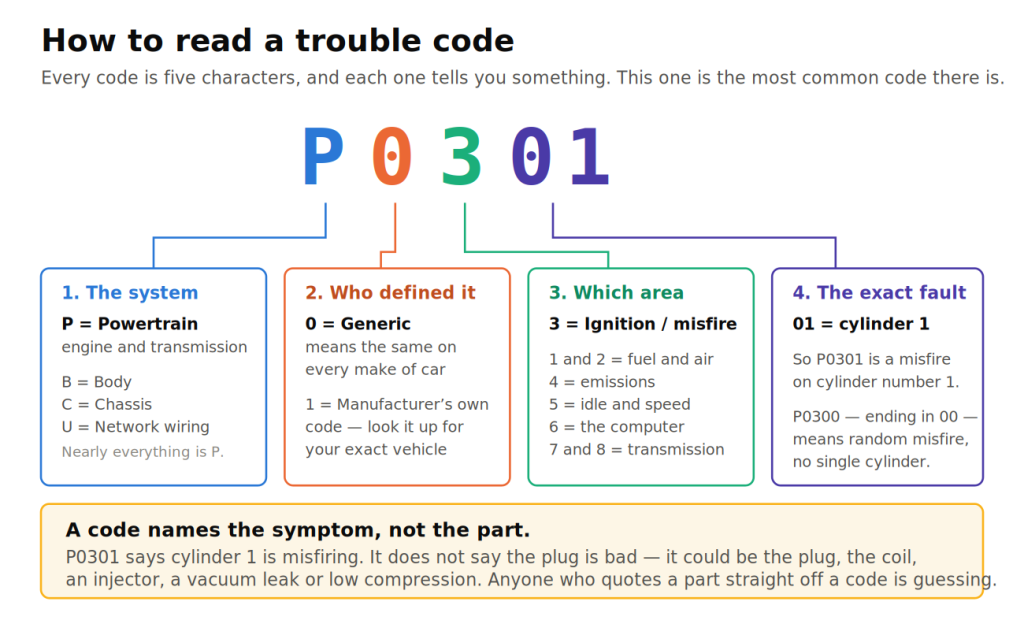
A code is five characters and every character means something. Once you can read the structure, you can tell at a glance whether you are looking at a misfire, an emissions fault or a transmission problem — before you look anything up.
What a code does not tell you
This is the part that costs people money. A code names a symptom, not a part.
P0301 says cylinder 1 is misfiring. It does not say the spark plug is bad. The cause could be the plug, the ignition coil, a fuel injector, a vacuum leak, a wiring fault, or low compression in that cylinder — which is a very different conversation. P0420, probably the most-quoted code in the world, says the catalytic converter is not working as efficiently as expected. That is frequently a failed oxygen sensor or an exhaust leak, not a $2,000 converter.
So the code is where diagnosis starts. Anyone who reads you a code and quotes a part in the same breath — a shop, a parts counter, or a video — is skipping the actual work.
Why not to clear the code right away
Clearing a code turns the light off. It does not fix anything, and it throws away two things you may want:
- Freeze frame data — a snapshot of engine speed, load, temperature and fuel trim at the moment the fault occurred. That snapshot is genuinely useful to whoever diagnoses the car, including you.
- Readiness monitors. Clearing codes resets the self-tests the car runs on its own emissions equipment. Until those complete — which can take days of mixed driving — the car will fail an emissions test for “monitors not ready,” even with no light on. If you are due for a test, this matters.
Read the code. Write it down. Fix the cause. Then clear it — or just let the car turn the light off itself once it sees the fault is gone, which it usually will after a few drive cycles.
The free option, and its limits
Most chain auto parts stores will read your codes for free in the parking lot. That is a genuinely good deal and a fine way to find out what you are dealing with.
Two things to keep in mind. The person reading it works at a parts store, so the answer will tend to arrive shaped like a part they sell — that is not dishonesty, it is just what they have to offer. And the free read usually will not give you freeze frame data or live sensor readings, which is where the actual diagnosis lives. Owning the tool costs about the price of one diagnostic fee and you can use it any time, including on a friend’s car or on a used car you are thinking of buying.
When to stop and take it in
- The light is flashing.
- The code involves the transmission, ABS, airbags, or anything you cannot reach without lifting the car.
- You have several codes at once across unrelated systems — that often points at a wiring or ground fault, which is real diagnostic work.
- The code came back after you fixed what you thought was the cause.
Walking into a shop already knowing the code is worth doing anyway. It tells them you are paying attention, and it makes the conversation about the diagnosis rather than about how much you can be told.
Information only, not professional advice. See the disclaimer.