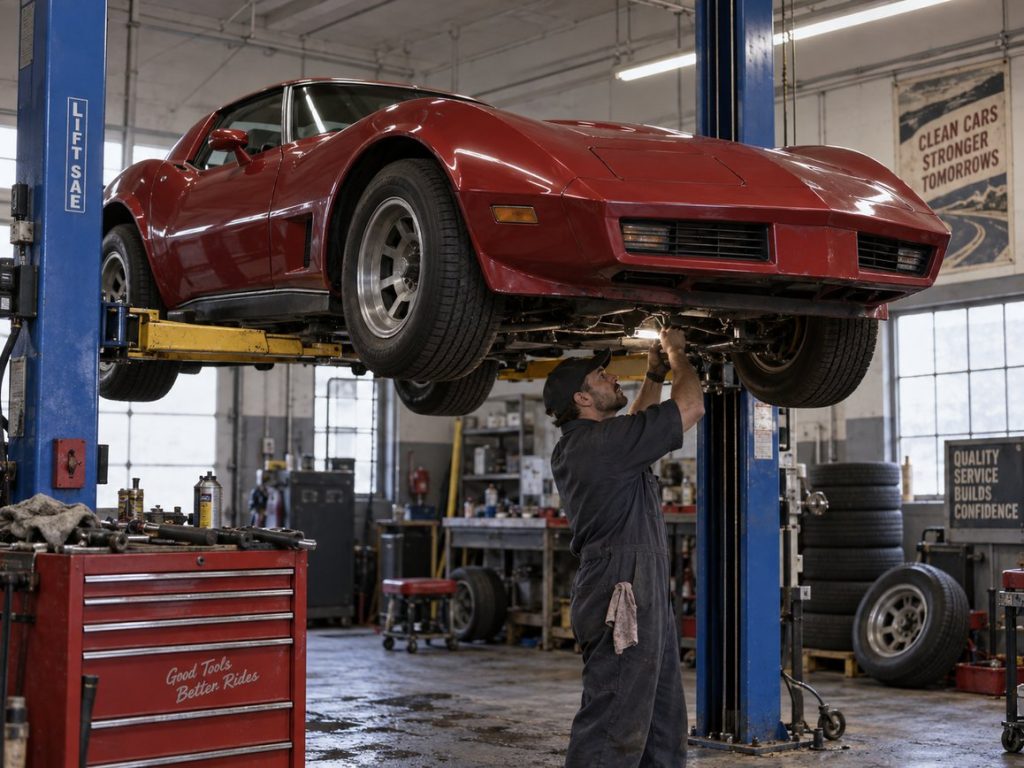
The classic first real job. Cheap, satisfying, and the one that teaches you your way around under the car.
- Time: 45 minutes the first time, 20 after that
- Difficulty: beginner-plus — the car has to come off the ground
- Shop: $65–$120 full synthetic. Parts: $30–$55. Saves: $35–$65 a time
Worth saying plainly: with quick-lube places advertising cheap oil changes, this one is not always a big money saver. What it buys you is knowing it was done properly, with the oil you chose, and the filter actually replaced.
Safety
Never get under a car held up by a jack alone. Jack stands or ramps, on solid level ground, wheels chocked. A jack is for lifting; stands are for holding.
Ramps are the easy answer for this job — you drive up onto them, chock the back wheels, and nothing has to be lifted at all. About $50 and worth it if oil changes are the main reason you would ever raise the car.
Warm oil drains better but hot oil burns. Run the engine three or four minutes, then let it sit ten before you touch the drain plug.
What you need
- Oil — the exact grade in your manual, such as 5W-30 or 0W-20, and the right quantity, usually 4 to 6 quarts. The manual gives both.
- An oil filter for your exact vehicle.
- A new drain plug washer if your car uses a crush washer. Pennies, and it is what stops a slow drip.
- A drain pan that holds more than you are draining.
- A socket or wrench for the drain plug, and an oil filter wrench.
- A funnel, rags, gloves, cardboard for under the pan.
The job
- Warm it briefly, then let it cool ten minutes. Park level, engine off, parking brake on, wheels chocked.
- Get the front up on ramps, or jack it and put it on stands. Shove the car firmly to check it is stable before you go under.
- Open the oil filler cap on top of the engine. It lets the oil drain faster and it is a reminder that the cap is off.
- Find the drain plug — a single bolt at the lowest point of the oil pan. Some cars have a plastic undertray with a small access hatch, or four screws to remove.
- Position the pan slightly to one side. The oil comes out sideways at first, not straight down.
- Loosen the plug with the wrench, then finish by hand. When it goes loose, push it in slightly as you spin it out so it comes free suddenly rather than dropping into the pan of hot oil.
- Let it drain five to ten minutes, until it goes from a stream to occasional drips.
- Fit the new washer, refit the plug. Snug plus a nudge — if you have a torque wrench, the manual gives a figure, usually 25 to 30 lb-ft. Overtightening strips the oil pan, which is a genuinely expensive repair.
- Move the pan under the filter and remove it, counter-clockwise. It is full of oil, so keep it upright as it comes off.
- Check the old gasket came off with it. If the rubber ring stayed stuck to the engine and you fit the new filter over it, you get a double gasket, and it will dump your oil onto the road. Run a finger round the mating surface to be certain.
- Wipe the mating surface, smear clean oil on the new filter’s rubber gasket, and spin it on by hand until it touches — then three-quarters of a turn more. Hand tight only. No wrench.
- Lower the car. Yes, before filling — you want it level.
- Add oil, a bit short of the full amount. Wait a minute, check the dipstick, top up to the upper mark. Refit the filler cap.
- Start it and let it idle 30 seconds. The oil light should go out within a couple of seconds. Look underneath for drips at the plug and filter.
- Shut it off, wait five minutes, check the dipstick again and top up if needed. Check under the car once more the next morning.
Getting rid of the old oil, free
Pour it into the empty new-oil bottles through a funnel, or keep the sealed jug the drain pan came with.
Most chain auto parts stores take used motor oil free — typically up to five gallons at a time. Many will take the old filter too. Some municipal recycling centres and repair shops also accept it. Call ahead rather than turning up with a full jug.
Never pour it down a drain, onto the ground, or in the bin. One gallon of motor oil is a serious environmental problem and dumping it is illegal.
How often
Whatever your manual says — typically 5,000 to 10,000 miles on modern synthetic. The 3,000-mile rule is a leftover from the 1970s that quick-lube chains have been happy to keep alive. Many cars also have an oil life monitor in the dash; trust it over a sticker on your windscreen.
The mistakes that catch people
- Double gasket. The classic, and it empties your oil onto the road.
- Overtightening the drain plug and stripping the pan.
- Wrenching the filter on. Hand tight. You have to get it off next time.
- Draining the transmission by mistake. It happens. The oil pan drain plug is at the lowest point under the engine, not the gearbox — if you are unsure, check a video for your car first.
- Forgetting the filler cap and starting the engine.
Information only, not professional advice, and no substitute for your vehicle’s service manual. Work on your own vehicle is at your own risk. See the disclaimer.