Almost everything that goes wrong at a repair shop goes wrong because nobody wrote the number down first.
A verbal quote is not a price. It is a number someone said in a noisy service lane while you were thinking about how to get to work. It cannot be checked later, it cannot be compared with another shop, and it cannot be enforced. A written estimate solves all three problems and takes about ninety seconds to ask for.
The sentence
“Please put it in writing before any work starts.”
That is the whole technique. You do not need to be confrontational, knowledgeable or clever. Say it pleasantly, at the counter, before you hand over the keys.
How a shop reacts to that sentence tells you a great deal. A good shop does it as a matter of course and will hand you a printout without being asked twice. A shop that gets vague, talks around it, or tells you it is not how they work has told you something useful — and it costs you nothing to go somewhere else.
Before you go: the phone call
Three questions, before you drive over:
- “What is your hourly labor rate?” A shop that will not tell you this on the phone is not going to get clearer in person. Nationally the average is around $132 an hour; Illinois runs about $135. Independents are usually $80–$130, dealers $130–$200.
- “What do you charge to diagnose it, and is that credited toward the repair if I have the work done here?” Diagnostic work is real work and deserves paying for. But you want the number in advance, and you want to know whether it disappears into the final bill or sits on top of it.
- “Will I get a written estimate before anything is done?” Ask it now, on the phone, so it is settled before you are standing there without a car.
What has to be on it
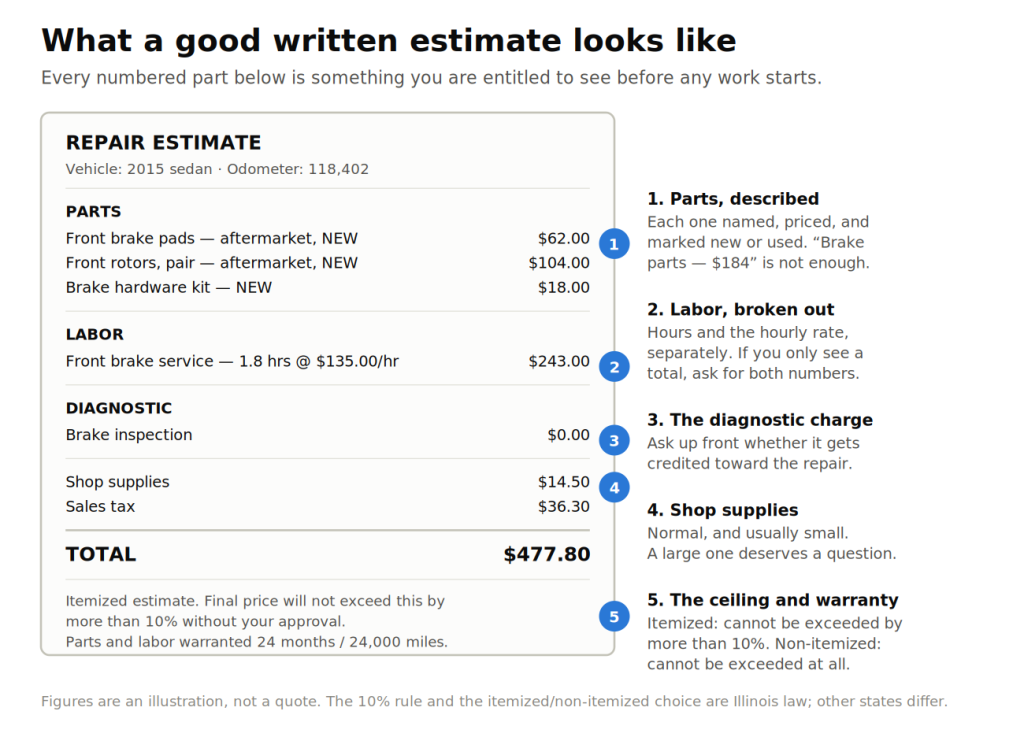
A real estimate is itemized. “Brakes — $480” is not an estimate, it is a number. Here is what a proper one looks like, and what each part of it is for.
The choice most people never get offered
In Illinois you can pick which kind of estimate you get, and the two behave differently:
- An itemized estimate — every part and labor line broken out. The final bill cannot exceed it by more than 10% without your approval.
- A non-itemized total — one number for the whole job. The final bill cannot exceed it at all.
Take the itemized one in almost every case. The 10% is worth giving up for being able to see what you are paying for — and it is the itemization that lets you compare two shops or spot a part billed at three times its price.
Under Illinois law a written estimate is required for any repair expected to run over $100, unless you waive it or there is no face-to-face contact. The shop also has to describe the parts and say whether they are new or used. This is not a favor they are doing you.
When they call with more work
They will, sometimes legitimately — things genuinely are found once a car is apart. The shop has to get your consent before going past the estimate, so this call is a decision point, not a notification. You are allowed to slow it down.
- “Send me the revised estimate in writing before you start that.” A text or email is fine. This is the single most useful thing you can say on that call.
- “What happens if I don’t do this today?” A genuine safety problem has a specific answer. An upsell usually produces a vague one.
- “Is that a safety item or a maintenance item?” Makes the person answer on the record.
- “Save the old parts for me, please.” Say it at drop-off if you can. Shops that know the parts are going home with you bill differently.
- You are allowed to say “do only what we agreed, and I’ll think about the rest.” You are not obliged to decide in thirty seconds on a phone call at work.
Checking the estimate against reality
- Multiply it out. Hours times the rate should equal the labor line. If it does not, ask why.
- Check the parts prices. Search the part name and your car. A modest markup over retail is normal and fair — the shop warranties it. Three times retail is a question.
- Compare the total against the ranges on the cost page. Being at the high end is not proof of anything; being at double the high end is worth a second quote.
- Get a second estimate on anything over about $500. An hour of your time against a possible few hundred dollars is good odds, and you now have a written document to show the second shop.
At pickup
Put the invoice next to the estimate before you pay. They should match, allowing for the 10% if it was itemized and you approved anything extra. The invoice must itemize parts and labor, show the odometer reading, state any warranty, and give the total.
Ask what the warranty is on the work and make sure it is written on the invoice — 12 months / 12,000 miles and 24 months / 24,000 miles are both common. A verbal warranty is worth what a verbal estimate is worth.
If it goes wrong anyway
- Talk to the owner or manager first, calmly, with the estimate and invoice in hand. Most disputes end here, and a shop that wants to keep its reputation would rather fix it than fight.
- Put your complaint in writing and keep a copy. Paper changes the tone of a conversation.
- File with the Better Business Bureau and, in Illinois, with the Attorney General’s consumer complaint process. That office exists for exactly this.
- Small claims court is a realistic last step for repair-sized amounts, and you do not need a lawyer for it.
One thing worth knowing: a shop cannot hold your car under a lien for repairs you never authorized. If that happens, it is not a negotiation — it is a complaint.
A plain-language summary of Illinois practice, not legal advice. Other states have their own rules. See the disclaimer.