Most disputes are settled at the counter by a calm person with a piece of paper. The steps after that exist, they work, and they are free — but they only work in order.
Before anything else: gather the paper
Every stage below asks for the same things, so collect them once:
- The written estimate and the final invoice.
- Any text messages or emails, and a note of phone calls — date, who you spoke to, what was said.
- Photographs of the car, the part, or the damage.
- The old parts if you have them, and any second opinion in writing.
- How you paid. A credit card gives you an extra route that cash does not.
Write a short timeline in plain sentences: what you brought it in for, what you were told, what you were charged, what went wrong. One page. You will use it four times.
Step 1 — The shop itself
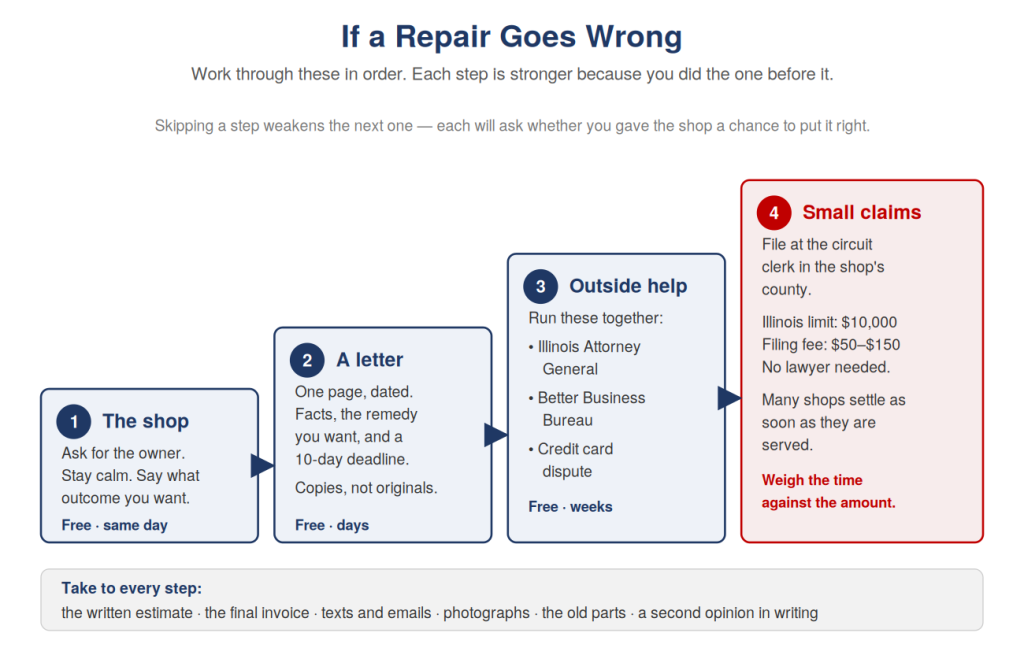
This resolves the large majority of disputes, and skipping it weakens everything that follows. Every later step will ask whether you gave the shop a chance to fix it.
- Go back in person, and ask for the owner or manager — not the person who wrote the ticket. Go at a quiet hour, not Monday morning.
- Stay calm and stay specific. “The estimate says $480 and the invoice says $790, and nobody called me” is unanswerable. “You people ripped me off” invites a shrug.
- Say what outcome you want. A refund of the difference, the job done again, or the part replaced. People cannot agree to something you have not asked for.
- Give them a fair chance to inspect it if the complaint is that the repair failed.
- Do not let another shop take it apart first if you want this one to stand behind the work.
If the conversation goes nowhere, say that you will put it in writing. That sentence alone changes the temperature more often than people expect.
Step 2 — A letter
Short, dated, unemotional, one page. Email is fine; certified mail is better if you think this may end in court, because it proves they received it.
What the letter contains
- Your name, the vehicle, and the dates it was in the shop.
- What was agreed, and what actually happened — facts only, no adjectives.
- The specific remedy you want, with a figure if there is one.
- A reasonable deadline — ten business days is standard.
- That you will otherwise file with the Illinois Attorney General and the Better Business Bureau.
- Copies of the estimate and invoice. Copies, never your originals.
Keep a copy of the letter itself. It becomes part of the record.
Step 3 — Outside pressure
These cost nothing and can run at the same time as each other.
| Where | What it does | Typical time |
|---|---|---|
| Illinois Attorney General — Consumer Fraud Bureau | Mediates between you and the business, and logs a complaint on their record. Free, online or by mail. | Weeks to a few months |
| Better Business Bureau | Forwards your complaint and publishes the outcome. No legal force, but businesses that care about their rating do respond. | Around 30 days |
| Credit card chargeback | Disputes the charge with your card issuer. Often the fastest real leverage there is. | Deadlines are tight — usually 60 days from the statement |
| City or county consumer affairs office | Some areas have one, and a local call can carry weight. | Varies |
Illinois has a specific regulation covering automotive repair — it is why you are entitled to a written estimate, to authorise work before it is done, and to have your old parts offered back. A complaint that points to a rule you can name is treated differently from one that says the shop was unfair. The Repair Shops hub sets out what those rights are.
Step 4 — Small claims court
Less intimidating than it sounds, and designed for exactly this. In Illinois small claims covers disputes up to $10,000, filing fees run roughly $50 to $150 depending on the amount and county, and you do not need a lawyer.
- You file at the circuit clerk’s office in the county where the shop is.
- Bring the timeline, the estimate, the invoice, photographs and a second opinion in writing. An independent written opinion from another mechanic is the single most useful document you can have.
- Being organised matters more than being eloquent. Hand the judge a clear file and a clear number.
- Many cases settle once the shop is served, before anyone appears.
Weigh it honestly: a day of your time and a filing fee to chase $200 is usually not worth it. To chase $1,800 it very much is.
If they are holding your car
A shop can hold a vehicle against an unpaid bill for work you authorised. It is a different matter when the charge is for work you never approved — and storage fees mount while you argue.
The practical move is usually to pay under protest and dispute afterwards: pay by credit card, write “paid under protest — disputed” on your copy of the invoice, take the car, and then pursue the chargeback and the complaint from home. It is far easier to argue about money than to argue while your car sits on someone else’s lot. If a large sum is involved, ring the Attorney General’s consumer line before you pay.
What makes a complaint work
- Paper beats memory. Every time, at every stage.
- One clear ask. A list of six grievances reads as a grudge; a single specific remedy reads as a claim.
- Calm wins. The person reading your complaint deals with angry people all day and is quietly grateful for one who is not.
- Move promptly. Card disputes have deadlines, and a complaint made three days later is stronger than the same one made three months later.
- Leave the review until the end. Posting it first turns a negotiation into a fight, and you lose your only piece of leverage.
And the best protection is the boring one that happens before any of this: get the estimate in writing, and never approve work over the phone without a figure attached.
A plain-language summary, not legal advice, and not a substitute for talking to a lawyer about your own situation. See the disclaimer.