This is the one where driving “just a few more miles” turns a small bill into an enormous one.
Right now, if the gauge is in the red or there is steam:
- Air conditioning off. Heater to full hot, fan on high. It is miserable and it genuinely pulls heat out of the engine.
- Pull over somewhere safe and switch the engine off. Do not try to reach home.
- Do not open the radiator or coolant cap. A hot cooling system is under pressure and opening it sprays boiling coolant upward, into your face. Wait at least 30 minutes.
1. What it probably is
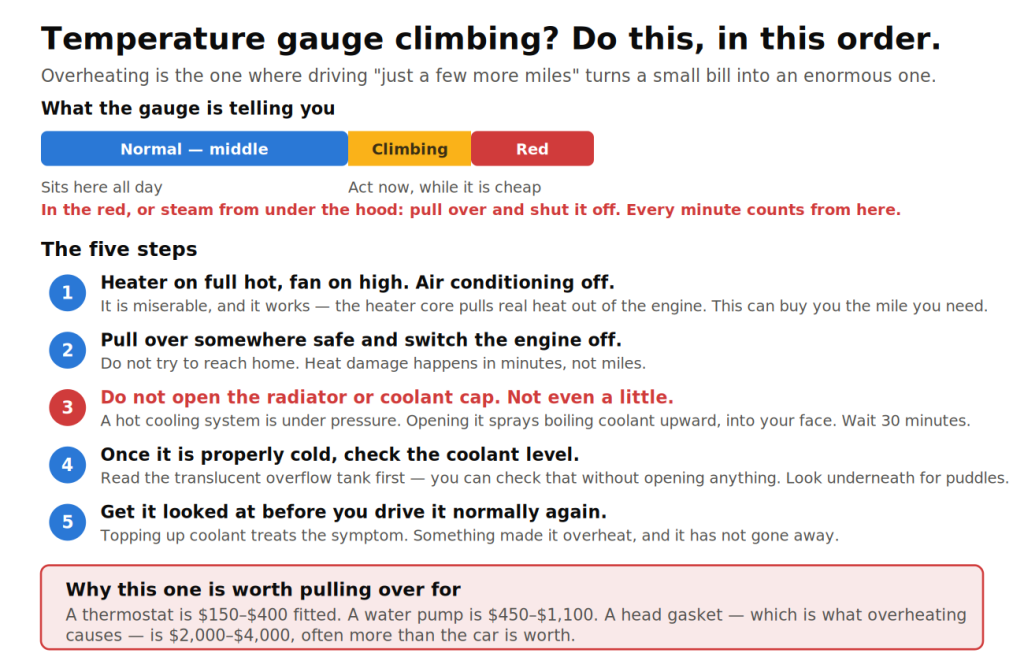
- Low coolant, from a leak. The most common cause by a distance. Coolant does not get used up — if it is low, it went somewhere.
- A stuck thermostat. Cheap part, and a classic cause of a car that overheats in traffic but is fine on the highway — or the reverse.
- A failed water pump. Often accompanied by a whine, or a drip from the front of the engine.
- A cooling fan not running. Overheats sitting in traffic, fine once moving. Can be the fan, its relay, or a fuse.
- A split hose or a failed radiator cap. Both cheap, both common.
- A blown head gasket. The expensive one — and usually the result of overheating rather than the cause, which is exactly why pulling over early matters.
2. The five-minute check
Once the engine is properly cold — not warm, cold:
- Read the overflow tank. It is translucent with MIN and MAX marks, and you can check it without opening anything. Empty or well below MIN tells you a lot.
- Look underneath. Coolant puddles are usually green, orange or pink, and feel slightly slimy rather than watery. Clear water under the car on a hot day is just air conditioning condensation and is normal.
- Look at the hoses. Obvious splits, crusty white or coloured residue around clamps, or a hose that feels rock hard or mushy.
- Idle it and watch the fan. Once it reaches temperature, the cooling fan should audibly kick in. If it never does and the gauge keeps climbing, that is your answer.
- Check the oil dipstick. Oil that looks like coffee with cream in it means coolant has got into the oil. That is head gasket territory — do not start the engine again.
3. Can you fix it yourself?
Mostly no, and this is one where that is the honest answer. Topping up coolant on a cold engine is fine as a stopgap, and a fuse or relay for a dead fan is a genuine DIY fix. A thermostat is sometimes reachable and sometimes buried.
Beyond that, cooling work involves scalding fluid, a system that has to be bled of air properly afterwards, and consequences that are measured in thousands rather than hundreds if it is wrong. Water pumps, radiators and head gaskets are shop jobs.
Topping up coolant treats the symptom. Something made it low, and that has not gone away. Also: never pour cold coolant into a hot engine, and use the coolant type your manufacturer specifies — they are not interchangeable.
4. What a shop should charge
| Repair | At a shop | DIY parts |
|---|---|---|
| Radiator cap or a hose | $80–$250 | $10–$60 |
| Thermostat | $150–$400 | $15–$50 |
| Coolant flush | $100–$250 | $20–$50 |
| Water pump | $450–$1,100 | $50–$200 |
| Radiator | $750–$1,850 | $150–$400 |
| Head gasket | $2,000–$4,000 | — |
Look at the top and bottom of that table together. That gap is the entire argument for pulling over.
5. What to watch out for
- A head gasket quoted without a test. There are specific tests — a block test for combustion gases in the coolant, a cylinder leak-down test. Ask which was done before accepting a four-figure quote.
- A radiator when a hose or cap would do. Ask where the leak was actually found.
- A coolant flush as the answer to overheating. A flush is maintenance. It does not fix a leak, a dead fan or a stuck thermostat.
- Sealant in a bottle. Stop-leak products can get you home in an emergency. As a repair they clog the system and make the eventual proper fix harder and dearer.
A starting point, not a diagnosis. See the disclaimer.